
Images from “Everyday The Same Dream”
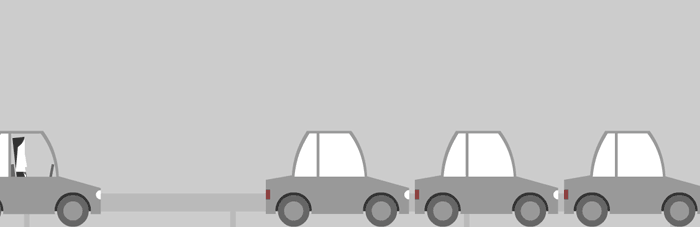
Images from “Everyday The Same Dream”
“You are late”
A little art game about alienation and refusal of labour.
( I love it )
by La Molle Industria
—Radical games against the dictatorship of entertainment
quotEnsemble #17
—The End of Work, Technology and a world where we can Just Be
“Imagine a world in which most people worked only 15 hours a week. They would be paid as much as, or even more than, they now are, because the fruits of their labor would be distributed more evenly across society. Leisure would occupy far more of their waking hours than work. It was exactly this prospect that John Maynard Keynes conjured up in a little essay published in 1930 called “Economic Possibilities for Our Grandchildren.” Its thesis was simple. As technological progress made possible an increase in the output of goods per hour worked, people would have to work less and less to satisfy their needs, until in the end they would have to work hardly at all. Then, Keynes wrote, “for the first time since his creation man will be faced with his real, his permanent problem—how to use his freedom from pressing economic cares, how to occupy the leisure, which science and compound interest will have won for him, to live wisely and agreeably and well.” He thought this condition might be reached in about 100 years—that is, by 2030.”
In Praise of Leisure by Robert Skidelsky and Edward Skidelsky—June 2012
ᔥ A Momentary Flow“So we’ll all forget about money, sit around and make art, and tell each other stories, while computers handle all the problems of the world. Why not?
Computers are already replacing folks with those shitty industrial revolution jobs. People say, what are they going to do? Like there’s a crisis - We’ve got to find something to keep all the unemployed busy. What are they going to do, dig ditches? Why don’t they make art? Of all the reasons to live, and participate in society, having a voice ranks higher than performing manual labour at the bottom of the skill set.
What’s important is that a broad range of people have access to the technology.
If the world is split into those that are wired, and those that aren’t, we will continue to walk the razor’s edge of revolution and civil strife.
If, on the other hand, we welcome the previously disenfranchised into the information age, and give them a voice along with ours, we can use this technology to unite the world —not in vying for market share, but with stories and art, celebrating the human experience.”
Justin Hall in “Decentralizing media for human potential”—June 13, 1995
ᔥ Justin’s Links➡➡➡➡➡➡➡➡➡
“When we, as a group decide that we want to apply our wisdom and solutions for human benefit and not for profit, then we will all have enough of whatever thing we need, and no need to compete out of fear of scarcity of what is available. This will remove the pressure from our lives, and allow for more “being”, which will then naturally yield us to want to create better solutions. We will be able to share ideas and inventions, with no need to hide it or patent it.
And, it is exactly when we share our solutions, for the benefit of all, that we begin to realize our true potential.
This is the moment to step back, regain some clarity about who we truly are and what we are able to do and, create a healthy and balanced world. A reality where we will use our collective consciousness, technology, ingenuity, creativity and solutions for what we are supposed to use them for: to give humans everything they need so we can just ‘Be’.”
Carla in “Like colored stitches in one same tapestry“—May 2010

Image from “Everyday The Same Dream”
A little art game about alienation and refusal of labour.

Images from “Everyday The Same Dream”
A little art game about alienation and refusal of labour.
We, Homo sapiens, are defined by what we know in the context of the Cosmos and the Earth — larger Whole Systems.
We, Homo sapiens, were in harmony with the Cosmos and the Earth during earlier centuries when indigenous wisdom prevailed. The evolution of social forms and technology toward ever-greater levels of complexity is part of our human development toward deeper consciousness and self-awareness. The technosphere, as José Argüelles and others have realized, is the necessary detour that takes us from the pristine biosphere to the psychically collectivized state of the noosphere.
”a misty Rose, rose in Blue⋰Notes ♥ Poetry
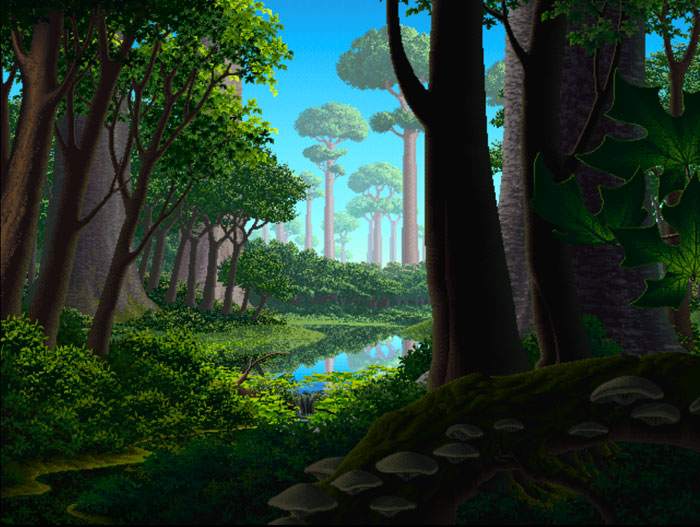
ᔥ image from Canvas Cycle: True 8-bit Color Cycling with HTML5
Art by Mark Ferrari — Code by Joseph Huckaby
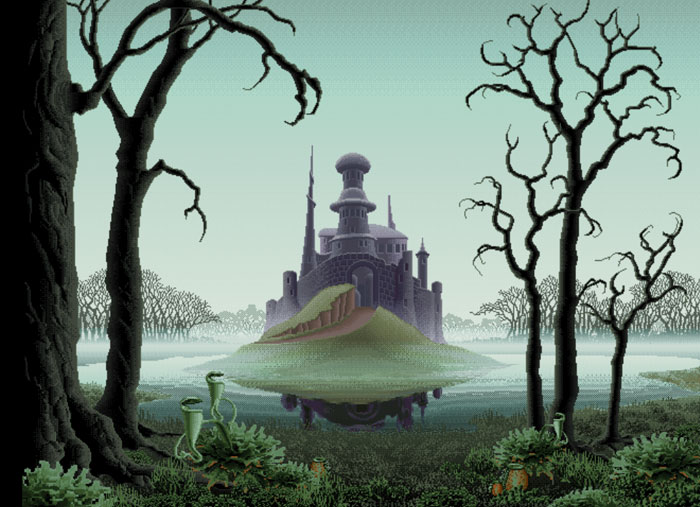
Mirror Pond—morning
ᔥ image from Canvas Cycle: True 8-bit Color Cycling with HTML5
Art by Mark Ferrari — Code by Joseph Huckaby
“The physicist Wolfgang Pauli and the psychologist C.G.Jung also explored the idea of a transcendent connection. Pauli for his part used the image of the speculum, or mirror, that while reflecting the objective into the subjective, and vice versa, belongs to neither. Jung explored the psychoid that bridges the order between mind and matter and, with Pauli, those meaningful patterns called synchronicities that transcend our temporary divisions of consciousness and matter.
For my part, I suggest that in our deepest moments we experience the world as inscape, rather than as an objectified, externalized, landscape. The word, inscape, itself comes from the English poet and priest, Gerard Manley Hopkins whose poetry probed the inner-dwelling-ness of nature. To engage the world as inscape therefore brings us close to what I mean by cosmology in its widest sense - in the sense of the existential immediacy of the cosmos as it presents itself to us, and our participation within it.
To see the world as inscape is to acknowledge that each of our experiences is limitless, authentic and unconditioned. To come into contact with nature, enter into a relationship, read a poem, watch a play, or contemplate a work of art is to open ourselves into an unlimited world of experience and a multiplicity of levels of meaning. Inscape calls upon us to seek and to respond to the authentic voice that lies within all things. It asks us to realize that all attempts at description, and all levels of existence are, of their very nature, provisional and contingent.”
F. David Peat - physicist and writer in COSMOS AND INSCAPE
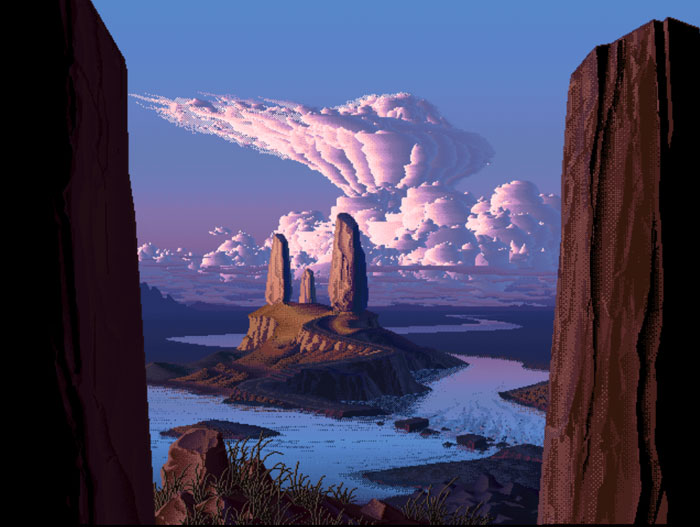
Aproaching Storm Day
ᔥ image from Canvas Cycle: True 8-bit Color Cycling with HTML5
Art by Mark Ferrari — Code by Joseph Huckaby
Memory Location definition:
A byte, word or other small unit of storage space in a computer’s main memory that is identified by its starting address (and size).
The byte is a unit of digital information in computing and telecommunications that most commonly consists of eight bits.
1byte = 8bits
The HTML DOM ( document object model ) defines a standard way for accessing and manipulating HTML documents.
The DOM presents an HTML document as a tree-structure.
The tree structure is called a node-tree.
1Byte of my apple

Jungle waterfall—morning
ᔥ image from Canvas Cycle: True 8-bit Color Cycling with HTML5
Art by Mark Ferrari — Code by Joseph Huckaby
I rise up the grass
From circles below
it colors me wiser
back to my flow
I travel the streets
of functions in dreams
what lies beneath
is not what it seems,
In inscapes of Silence
tags are bird < wings >
sitting on saplings,
their nodes
and their strings.
Figments of Web
Transfusion in notes
One byte of my apple,
eight bits in flakes
Snow in my DOM(e).
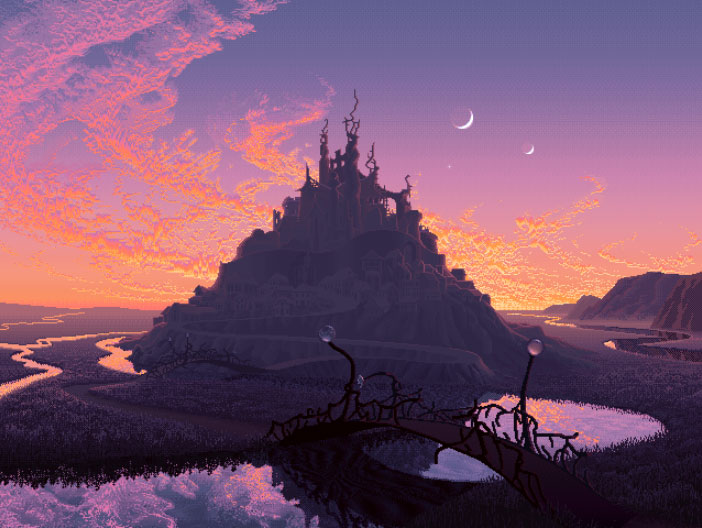
mountain fortress—dusk
ᔥ image from Canvas Cycle: True 8-bit Color Cycling with HTML5
Art by Mark Ferrari — Code by Joseph Huckaby
“(The flux of the physical is meeting the flux of the digital) within the flux of the mental.”
ᔥ noosphe.re
illustration by Tiff McGinnis
MJ3 by TheGrandeDame on Flickr.
” Very few people are looking at this digital universe in an objective way. Danny Hillis is one of the few people who is. His comment, made exactly 30 years ago in 1982, was that “memory locations are just wires turned sideways in time”. That’s just so profound. That should be engraved on the wall.Because we don’t realize that there is this very different universe that does not have the same physics as our universe. It’s completely different physics. Yet, from the perspective of that universe, there is physics, and we have almost no physicists looking at it, as to what it’s like. And if we want to understand the sort of organisms that would evolve in that totally different universe, you have to understand the physics of the world in which they are in. It’s like looking for life on another planet ( … )
A UNIVERSE OF SELF-REPLICATING CODE by George Dyson
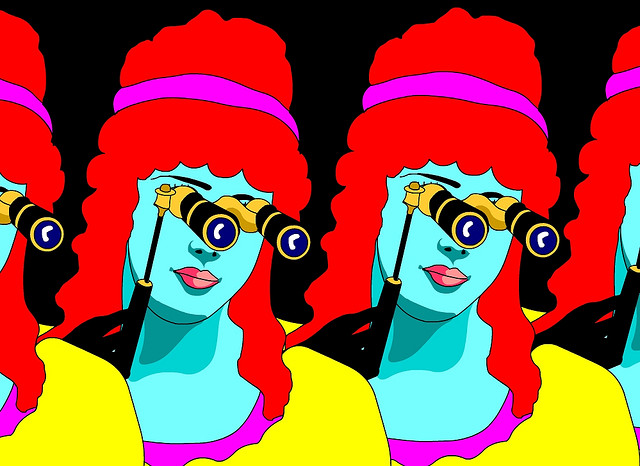
Illustration by Tiff McGinnis
opera glasses by TheGrandeDame on Flickr.
A Universe Of Self-Replicating Code by George Dyson
ᔥEdge
in “Bringing remoteness to immediacy - We are all techno-shamans”
ᔥA Momentary Flow
Michael Talbot in “The Holographic Universe”—Traveling in the Superhologram

illustration by Tiff McGinnis
ᔥ wingsfinal by TheGrandeDame on Flickr.
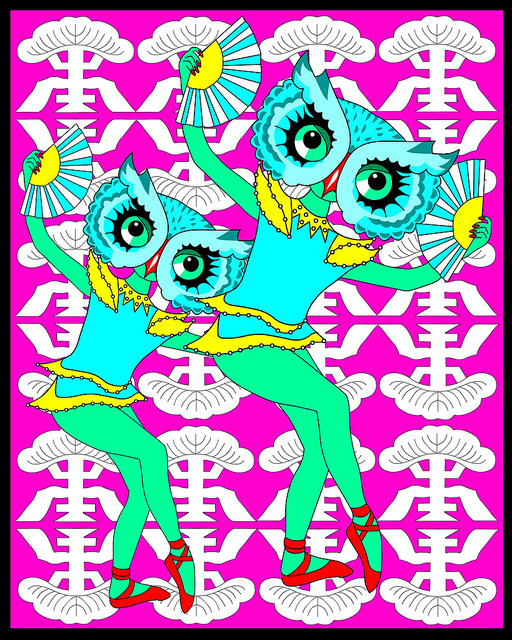
Owl Dancers by TheGrandeDame on Flickr.
ᔥFlickr:
Owl Dancers by Tiff McGinnis
“What I was trying to say is that this digital universe really is so different that the physics itself is different. If you want to understand what types of life-like or self-reproducing forms would develop in a universe like that, you actually want to look at the sort of physics and chemistry of how that universe is completely different from ours. An example is how not only its time scale but how time operates is completely different, so that things can be going on in that world in microseconds that suddenly have a real effect on ours.”
A UNIVERSE OF SELF-REPLICATING CODE by George Dyson