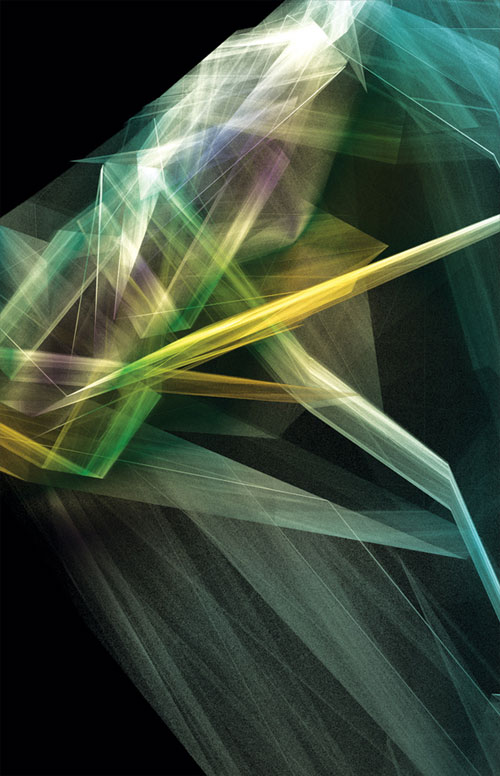
Feminine Polynomials
Generative Artworks / Polynomial Functions by Ozan Turkkan
On Self-Organizing Systems
“Beyond serving as an inspiration to engineers, the group behavior of fireflies has broader significance for science as a whole. It represents one of the few tractable instances of a complex, self-organizing system, where millions of interactions occur simultaneously—when everyone changes the state of everyone else. Virtually all the major unsolved problems in science today have this intricate character.
Consider the cascade of biochemical reactions in a single cell and their disruption when the cells turns cancerous; the booms and crashes of the stock market; the emergence of consciousness from the interplay of trillions of neurons in the brain; the origin of life from a meshwork of chemical reactions in the primordial soup.
All these involve enormous numbers of players linked in complex webs.
In every case, astonishing patterns emerge spontaneously.The richness of the world around us is due, in large part, to the miracle of self-organization.
Unfortunately, our minds are bad at grasping these kinds of problems.
We’re accustomed to thinking in terms of centralized control, clear chains of command, the straight forward logic of cause and effect. But in huge, interconnected systems, where every player ultimately affects the other, our standard ways will fall apart. Simple pictures and verbal arguments are too feeble, too myopic.”
Steven Strogatz in “Sync-How order Emerges From Chaos in The Universe, Nature and Daily Life“—(pp.34 paperback edition)
/////////////////////////////////////
“[…] we must now recognize that we, our organizations, as indeed the entire cosmos – are all self organizing systems. Not just a little bit, not just in some special part, but from beginning to end, top to bottom. It is all self-organization. The implications of this recognition, should it prove to be valid, are two fold (at least).
First, a large part of what we currently devote a good deal of time and energy to – organizing things – is wasted effort, for our systems, left to their own devices, will take care of that business pretty much all by themselves.
Secondly, our efforts at organization and control are not only of questionable value, but also destructive. By imposing our view of organization on a self-organizing system we essentially throw a spanner in the works, thereby reducing organizational function, and our own levels of performance.”
“Five Epochs Of Civilization” — In Search of a Pattern (pp.30,31) by William McGaughey
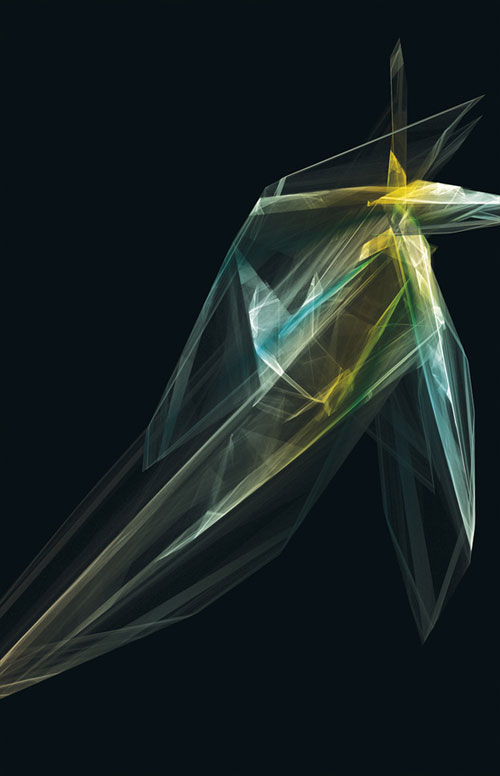
Feminine Polynomials
Generative Artworks / Polynomial Functions by Ozan Turkkan
As a society, Western civilization is now ebbing as we’ve reached the peak performance of our knowledge and systems and we are now “repatterning” into more complex networks and higher levels of consciousness while getting rid of the dross.
Our technologies allowed and are allowing for this to happen but they are just tools.
There is no chaos in self-organizing systems, we are just evolving and at the cusp between two very different ways of being.
“repatterning,
n the therapeutic touch phase in which the practitioner revisits the sites of imbalance noticed in the clearing phase and modifies the localized energy reversing its status (i.e., if cold, the practitioner warms it). Also called balancing.”
Carla
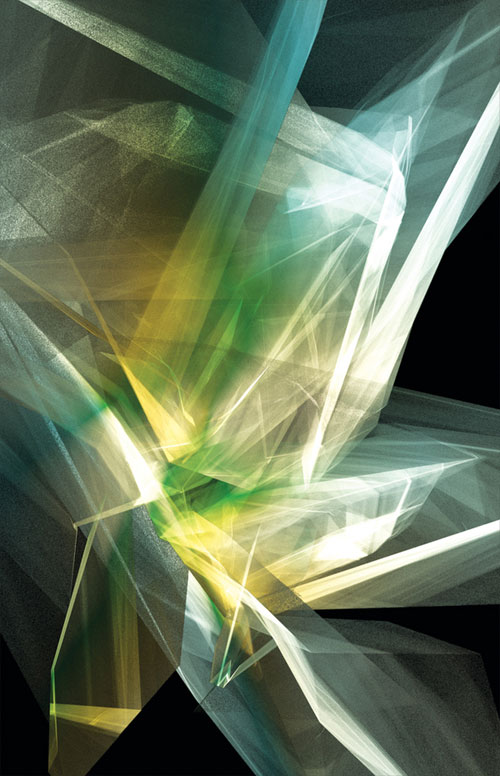
Feminine Polynomials
Generative Artworks / Polynomial Functions by Ozan Turkkan
Five in a Million
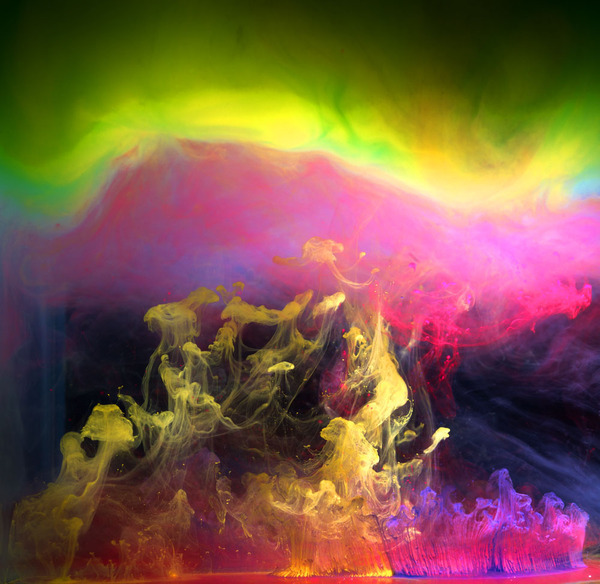
Aqueous Fluoreau by Mark Mawson
ᔥ Behance
Bill in “True Blood”
Richard Bach in “Jonathan Livingston Seagull - a Story”

Aqueous Fluoreau by Mark Mawson
ᔥ Behance
“Carl Jung spoke passionately about the Conjunctio, a marriage of sorts, between the numinous and humans, between two lovers, between the sacred feminine and sacred masculine, etc. Yet, in order to experience this meeting between my Self and something bigger, deeper, wiser, etc., it required a certain sense of consciousness.
Conjunctio is a love story. It is the meeting of two parts at some intersecting point where everything that is, was and will be, come together and come apart. It is the place where I experience you experiencing me and it is my consciousness that allows me to register the moment, hopefully using it to grow and connect with myself. There is something about plunging into a dark pool of water that is mysterious and interesting.”
ᔥ Jeffrey Sumber’s blog — “Conjunctio: A Love Story”
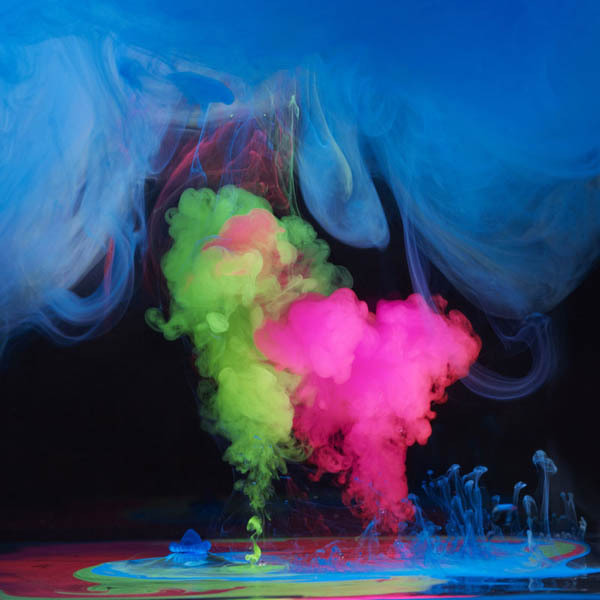
Aqueous Electreau by Mark Mawson
ᔥ Behance
quotEnsemble #21 On Love and The Myth of Twin Flame❤
“There is a mythical story in Plato’s Symposium.
Originally, humans existed as bisexual creatures with two sets of arms, legs, and sexual organs. But the power of these bisexual creatures was so great that the gods feared a usurpation of the prerogatives of heaven.Therefore, Zeus cut the creatures into two.
Thereafter, the divided humans forever sought their missing halves.
This story metaphorically captures the unconscious drive we have to make the unconscious archetypes of anima or animus conscious so that we can become whole.
But the unconscious drive is not only instinctual, it is also Freud’s Eros of the personal unconscious. Eros is augmented by creativity from the collective unconscious.”
Amit Goswami, theoretical physicist in “The Self-Aware Universe - how consciousness creates the material world”
“The ideal of becoming addicted to people and/or their energies can seriously halt your spiritual development.
The most common instance is if one spontaneously “falls in love/lust”. This addiction stems from missing the complimentary trait that we need or think we need.
The opposite sex gives us access to the energy we lack due to our own non-integration of our spiritual side.
In so doing this, we disconnect them and ourselves from the Universe.
If an addiction is realized then one must work on getting the energy from the Universe as a whole and not other individuals.
(…) We have to remember Energy is both male and female and automatically compensates for what we need. Do you see the complimentary beauty in this balance?
Stabilizing energy is important. In the spiritual scheme of things you will undoubtedly attract higher relationships that will not pull you from your individual evolution.
Each person you meet has the potential to uplift your spiritual knowledge and likewise, you may aid others in their spiritual journey.
Synchronistic energies will happen. How wonderful is that?!”
Virtuous attractions
In moments of lessness
Perhaps I shall remember
Virtuous attraction
Embody characteristics I wish to attract
When I am feeling incomplete
Which quality of my vision
Could I embody next?
By Justin Hall
For ❤ “Flame With No Twin”
Book Of Cobalt
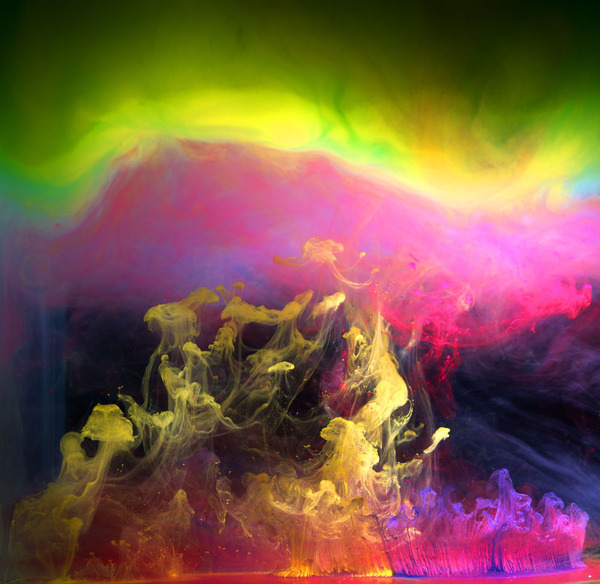
Aqueous Fluoreau by Mark Mawson
ᔥ Behance
in Where the Heart Beats: John Cage, Zen Buddhism, and the Inner Life of Artists
↬ Brain Pickings
Gilles Deleuze
❤quotEnsemble #20—On Love, Princesses and The Illusion Of Separateness❤
❤So, when do I get my fairytale ending? My princess or prince? My knight in shining armour? Where’s my true love who will sweep me off my feet and let us live happily ever after? Since when did any of the fairy tale’s we grew up wishing happened to us , ever happen in real life?❤
❤Princesses always believe
in Love and Strawberries
And all the Red Things
crossing Our Worlds❤
❤How could we forget those ancient myths that stand at the beginning of all races, the myths about dragons that at the last moment are transformed into princesses? Perhaps all the dragons in our lives are princesses who are only waiting to see us act, just once, with beauty and courage. Perhaps everything that frightens us is, in its deepest essence, something helpless that wants our love.❤
Rainer Maria Rilke in ” Letters to a Young Poet”

Aqueous Fluoreau by Mark Mawson
ᔥ Behance

Aqueous Fluoreau by Mark Mawson
ᔥ Behance
quotEnsemble #19—On movement, order and shapeshifting meanings
in book “New Aesthetic New Anxieties”
ᔥ Booki
↬“It’s supposed to hurt to think about it!”
ᔥ Scienceblogs
David Bohm in “Wholeness and the Implicate Order”
“A field of ethereal poetic forms and integrative relational structures, in a state of perpetual flux, moving and morphing with no aim or intended goal. Like a transparent superfluid with zero viscosity, beautifully ebbing and flowing in a frictionless medium to the iridescent tune of a symphony of an infinite spectrum of colours.”
THE SPREZZATURA FIELD by Ahmed Salman { Via } Noosphe.re
Links of my own to be replaced soon
Carla
❊
“The secret breathed within
And never spoken, woken
By music; the garlands in
Her hands no one has seen.
She wreathes the air with green
and weaves the stillness in.”
May sarton — “The Clavichord,” lines 13-18 (1948 )
For Lull Lilies
Lull Lilies
Lull Lilies They Sing Lullabies of the String
Boltzman discovered that physics and thermodynamics are two sides of the same coin (in fact, a physical theory like superstring theory is undefined without the laws of thermodynamics). As physical matter (superstrings) becomes more harmonious, entropy increases. The will-to-harmony and entropy are inseparable.
They are the crests and troughs of the same wave: It seems obvious after seeing the bottom graph why everything we experience in this universe seems to move in cycles. Spring, summer, fall, winter. Birth, adolescence, adulthood, death. Good fortune then bad fortune then good fortune then bad. We live in a cyclical universe.
But is the harmony/entropy wave not also a graphical expression of the tiniest building block of our universe: the vibrating superstring? Superstring theory claims that from the most cosmic to the most minute level, from the Milky way to Planck’s length (10-33cm), we live in a wave-composed universe which we (each one of us!) can only experience as stuff (discrete particles) arranged in wavelike patterns.
Quantum theory tells us that even presence itself is a wave— of probability.
Joshua parkinson in The Consequences of String Theory for Knowledge and Representation
Herbolarium (a garden revisited)
The near stillness recalls what is forgotten, extinct angles.
quote by Georg Trakl
At this moment creating web contents, no matter how meaningful and thought it might be - when many are still unable to understand how to use the tools, how to protect themselves, how to apply basic rules of social interaction online and, above all, how to have freedom to make their own choices - it has only the same effect of providing books for free to an entire population when only half is able to read.
It is not about trying to find a language that fits the medium but, about finding the language that explains the paths this medium brings and how it can shape our future towards betterment…
And I believe the direction is in finding a language that seeks its roots in the feelings and emotions that we, as humans, all share.
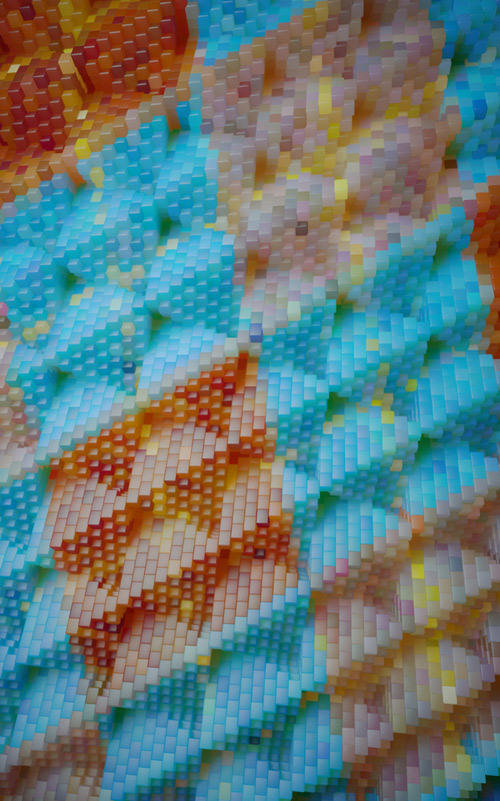
image from Sample Sample nanoscopic materials inspired by images of fabric materials
Even if Internet protocols enable decentralization (representing a decentralized circuit), they are based upon forms of control of an invisible kind, iterating through series of different nodes, giving the impression there is freedom—but it is a customised freedom at best, at worst a kind of prison.
Even inside this limited sphere we are losing or giving away our freedoms—more and more people are trading privacy for convenience.
Web 2.0, as embodied by Facebook and Twitter, has some resemblances to the shopping mall, being promoted as a way of meeting new people, or getting in touch with old friends, or keeping everyone informed of your activities.
It is a social mall where the commodity for sale is personality.
””[…] When we treat information systems as no more than conduits between human imaginations, grand vistas open up. The pleasant news computer scientists can infer from the public’s early embrace of computer tinkering is that we will not be serving a population of consumers, but rather of creators.
In the next fifty years, computer science will give birth to a delightful new vernacular art form that combines the three great art forms of the twentieth century; cinema, jazz, and programming.
The result will be a mass theater of spontaneous shared imagination and dreaming.
My fond hope is that it will take the form of networked VR with inspirational authoring tools that are capable of quick, improvisatory creation. But whatever the specific form, what we are building will encourage people to share interior vision and treat it as a tangible, worthy thing, even into adulthood.”
ᔥ Jaron Larnier in The Frontier Between Us
image from Sample Sample nanoscopic materials inspired by images of fabric materials
W. DANIEL HILLIS in The Dawn Of Entanglement
ᔥ EdgeThis separation is fundamental. The Web is an application that runs on the Internet, which is an electronic network that transmits packets of information among millions of computers according to a few open protocols. An analogy is that the Web is like a household appliance that runs on the electricity network. A refrigerator or printer can function as long as it uses a few standard protocols—in the U.S., things like operating at 120 volts and 60 hertz. Similarly, any application—among them the Web, e-mail or instant messaging—can run on the Internet as long as it uses a few standard Internet protocols, such as TCP and IP.
Manufacturers can improve refrigerators and printers without altering how electricity functions, and utility companies can improve the electrical network without altering how appliances function. The two layers of technology work together but can advance independently. The same is true for the Web and the Internet. The separation of layers is crucial for innovation.
TIM BERNERS-LEE in Long Live the Web: A Call for Continued Open Standards and Neutrality: Scientific American
ᔥ Scientific American
image from Sample Sample nanoscopic materials inspired by images of fabric materials
Harkaway @ The Daily Beast
[on issues discussed in - of course - The Blind Giant]
(via theblindgiant)
image from Sample Sample nanoscopic materials inspired by images of fabric materials
quotEnsemble#18—The Internet, the Web and Human cacophony
“Storytelling on the web is like wrangling wild beasts and piranhas in the middle of a sandstorm with screaming gypsies at your back. ”
Jonathan Harris in Wired - the sum of all emotions…
ᔥ wired uk
“The computer world is like an intellectual Wild West, in which you can shoot anyone you wish with your ideas, if you’re willing to risk the consequences. ”
Paul Graham in “Hackers & Painters: Big Ideas from the Computer Age”
“… We can rule certain images out right at the start. We know, contra former Sen. Ted Stevens, that the Internet is not a ‘series of tubes.’ We know that ‘the Wild West’ doesn’t fit, not for a landscape that’s been so nicely parceled, policed and manicured. We also know that it’s not that other ’90s favorite, an ‘information superhighway’— the point of a highway is to get somewhere, after all, somewhere that is not a highway, while the point of the Internet is to stay there, forever and ever, like a hot tub. A hot tub, after all, is shared with friends and strangers, whose warm water swirls around you, lulling you into complacency while silently transmitting disease. Yes: The Internet is definitely more like a hot tub than a highway.”
Christine Smallwood in “What Does the Internet Look Like?”
this essay originally appeared in The Baffler, Vol. 2 issue 1
“Perhaps I should explain where I’m coming from. I had (and still have) a dream that the web could be less of a television channel and more of an interactive sea of shared knowledge. I imagine it immersing us as a warm, friendly environment made of the things we and our friends have seen, heard, believe or have figured out. I would like it to bring our friends and colleagues closer, in that by working on this knowledge together we can come to better understandings.
If misunderstandings are the cause of many of the world’s woes, then can we not work them out in cyberspace. And, having worked them out, we leave for those who follow a trail of our reasoning and assumptions for them to adopt, or correct.”
Tim Berners-Lee in Hypertext and Our Collective Destiny (1995)
image from Sample Sample nanoscopic materials inspired by images of fabric materials
“The world wide web went live, on my physical desktop in Geneva, Switzerland, in December 1990. It consisted of one Web site and one browser, which happened to be on the same computer. The simple setup demonstrated a profound concept: that any person could share information with anyone else, anywhere. In this spirit, the Web spread quickly from the grassroots up.
Today, at its 20th anniversary, the Web is thoroughly integrated into our daily lives.
We take it for granted, expecting it to “be there” at any instant, like electricity.[…]
Yet people seem to think the Web is some sort of piece of nature, and if it starts to wither, well, that’s just one of those unfortunate things we can’t help. Not so. We create the Web, by designing computer protocols and software; this process is completely under our control. We choose what properties we want it to have and not have.
It is by no means finished (and it’s certainly not dead). If we want to track what government is doing, see what companies are doing, understand the true state of the planet, find a cure for Alzheimer’s disease, not to mention easily share our photos with our friends, we the public, the scientific community and the press must make sure the Web’s principles remain intact—not just to preserve what we have gained but to benefit from the great advances that are still to come.”
”